

Ph.D. Student Publishes Research Paper on Martian Dust Storms
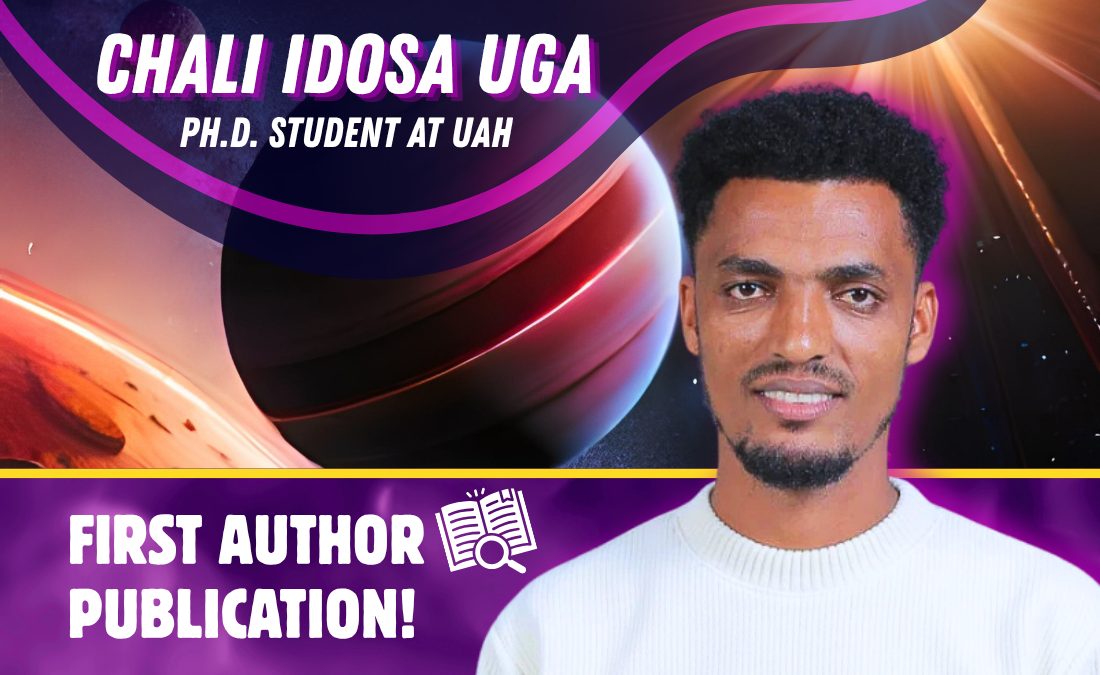
FTPP is proud to recognize CSPAR student Chali Idosa Uga on the publication of his first major paper for his Ph.D. thesis research at The University of Alabama in Huntsville.
Uga recently published a study in The Planetary Science Journal that explores how dust storms on Mars may influence the planet’s electrical environment. Conducted alongside his mentors, Dr. Gary Zank and Dr. Dennis Gallagher, the research examines how dust particles, atmospheric turbulence, and electrical charging processes interact during large Martian dust storms.
The study focuses on the Martian Year 34 global dust storm and investigates how storm activity may create electrical conditions near the planet’s surface that could be important for future robotic and human exploration of Mars.
A Passion for Space Weather Research
Uga’s interest in the project grew from a broader fascination with space weather and planetary environments. “My interest in space weather began with studying how the Sun affects planetary environments,” Uga says. “Over time, this interest expanded to other planets, including Mars, where the atmosphere, dust storms, and interaction with space create a very different but scientifically important environment.”
His inspiration for the project began while studying Earth’s Global Electric Circuit, the planet-wide electrical system that connects thunderstorms, clouds, aerosols, and charged particles throughout the atmosphere.
“This made me curious about whether similar electrical processes could occur on other planets, especially Mars, where dust storms are a major part of the atmosphere,” Uga says. After discussing the concept with Professor Gary Zank and Dr. Dennis Gallagher, Uga developed the idea into a research project that eventually became this publication for his thesis.
The project took approximately one academic year to complete, from the initial concept to publication. Throughout the process, Uga received guidance from both mentors as he developed the research framework, analyzed results, and prepared the manuscript for publication.
“My collaborators and mentors played an important role in helping this project grow from an initial idea into a published study,” he says. “Professor Zank encouraged me to explore this connection carefully and helped me think about the problem in a broader planetary and space physics context.” Uga also credits Dr. Gallagher’s feedback with helping strengthen the scientific interpretation and clarity of the work.
The Societal Impact

“This research helps us understand Mars as an active atmospheric and electrical system, not only as a dry and dusty planet”
His study provides a framework for identifying when and where electric fields may build up during major Martian dust storms, helping scientists better understand the conditions that future missions may encounter.
While Mars may seem far from everyday life on Earth, understanding the Martian environment is becoming increasingly important as scientists prepare for future exploration missions. According to Uga, dust is one of the greatest environmental challenges on Mars. Dust storms can reduce visibility, alter atmospheric conditions, and create challenges for spacecraft, scientific instruments, rovers, and future human explorers.
“If dust particles become electrically charged during storms, they may affect how dust interacts with spacecraft surfaces, scientific instruments, and future exploration equipment,” Uga says. “Understanding these effects can help scientists and engineers better prepare for the Martian environment and reduce possible risks during future missions.”
Beyond future exploration efforts, the research contributes to a broader understanding of how planetary atmospheres behave beyond Earth.
Chali’s publication represents both a personal milestone and an impactful contribution to the growing research of Mars, planetary atmospheres, and space weather. His work highlights the innovative research being conducted while helping advance our understanding of the environments that exist throughout our solar system.