

Former FTPP Graduate Student Publishes Paper from Ph.D. Research
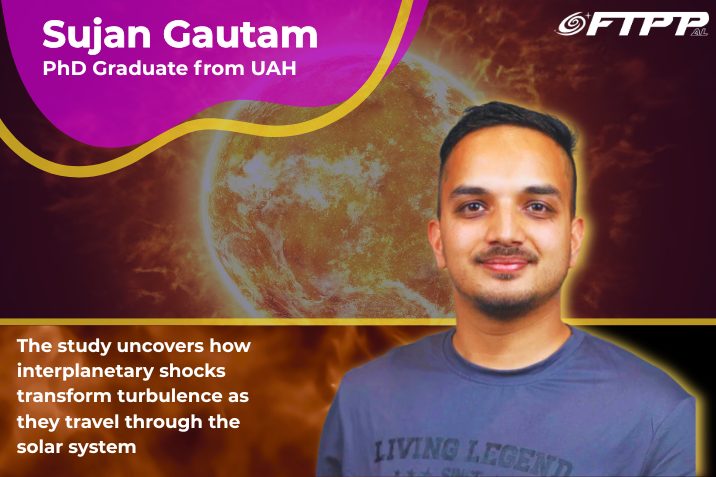
Former FTPP graduate student Dr. Sujan Gautam has published the fourth first-author paper from his Ph.D. research. The study was completed and submitted during his doctoral studies in the Department of Space Science at the University of Alabama in Huntsville, with the manuscript submitted on April 11, 2026, just weeks before his UAH graduation on May 4, 2026.
The paper was recently accepted and published, marking another significant milestone from his doctoral research. Dr. Gautam is currently a Postdoctoral Researcher in the Department of Physics and Astronomy at the University of Delaware.
New Insights into Shock-Driven Plasma Evolution
The research provides the first detailed observational study of how turbulence and different magnetohydrodynamic (MHD) wave modes evolve as the same interplanetary shock travels outward from the Sun. By tracking a coronal mass ejection (CME)-driven shock using observations from the Solar Orbiter and Wind spacecraft, Dr. Gautam and his collaborators were able to examine how the shock processes and transforms turbulence throughout its journey across the heliosphere.
The study demonstrates that while the shock significantly amplifies turbulent energy and strengthens the turbulent cascade, it also systematically reorganizes the contributions of different MHD wave modes, changes the anisotropy of the turbulence, and alters the transfer of energy between wave modes. These observations provide new insight into the dynamic processes that shape space plasmas after shocks pass through them.
Understanding how shocks modify and transport turbulence is essential for advancing our knowledge of plasma heating, turbulence evolution, and the acceleration of energetic particles in space. These processes influence space weather throughout the heliosphere and are fundamental to understanding the environments surrounding the Sun and other astrophysical systems.
This publication highlights the impactful research conducted within UAH’s Department of Space Science and the FTPP program, while recognizing the support of the funding organizations that made this work possible. Congratulations to Dr. Gautam on this outstanding achievement and on the continued success of his research career.